
South Florida attic guide
Choose the insulation that fits the attic—not just the label.
Blown-in insulation often works well across irregular attic floors and around obstacles. Batts can work well in accessible, regularly spaced framing when carefully fitted. Neither is automatically better in every home. The right choice depends on coverage, installation quality, existing conditions, and the insulation level the project needs to achieve.
When comparing blown-in insulation vs. batts, it is tempting to look for one clear winner. But two products with similar thermal ratings can deliver different results if one leaves gaps, gets compressed, or covers an unresolved attic problem.
For a South Florida home, the practical question is this: which approach can provide consistent, properly installed coverage in the attic you actually have?
A professional attic insulation installation should begin with an inspection and a clear scope—not a material recommendation made before anyone checks the space.
In this guide
Know your attic type: This comparison focuses on conventional vented attics insulated at the attic floor, above the living space. An unvented attic insulated at the roofline is a different assembly. Have that design evaluated before adding insulation or changing ventilation.
What is the difference between blown-in insulation and batts?
Blown-in insulation: loose material installed with equipment
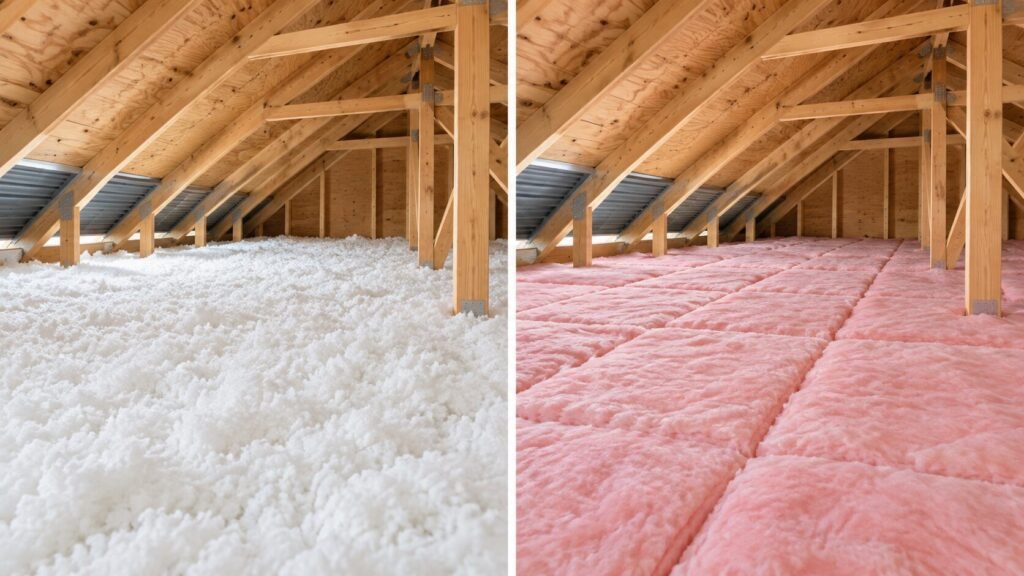
Blown-in, or loose-fill, insulation consists of small fibers or particles installed with a blowing machine. Common materials include fiberglass and cellulose. The material can conform around framing and obstacles, making it useful in many existing attics.
Its performance depends on installing the specified amount at the correct coverage and depth. A surface that looks fluffy is not proof that the intended R-value has been achieved.
Batt insulation: pre-cut sections fitted into place
Batts are manufactured in defined sizes, commonly suited to standard framing spacing. Fiberglass is a familiar example, although batts are also available in other materials. Rolls are a related blanket-insulation format supplied in longer lengths.
Batts must be fitted around obstructions without leaving gaps or being folded and compressed. Straightforward, accessible framing can make that easier; irregular spaces require more careful cutting and placement.
Important: “Blown-in” describes an installation format, not one specific material. A fair proposal comparison should identify both the format and the actual product.
Blown-in insulation vs. batts at a glance
| Consideration | Blown-in insulation | Batt insulation |
|---|---|---|
| Irregular spaces | Conforms around many obstacles and unevenly shaped areas. | Needs careful cutting and fitting around obstructions. |
| Installation method | Installed with a blowing machine and hose. | Placed and fitted by hand. |
| Quality checks | Product quantity, specified depth, and even coverage. | Correct fit, full thickness, and no gaps or compression. |
| Existing insulation | May be added over suitable existing material after inspection. | May be used in an approved layering plan with appropriate fit and facing. |
| Air sealing | Does not replace a separate attic air-sealing plan. | Does not replace a separate attic air-sealing plan. |
Which option makes more sense for your attic?
Blown-in insulation is worth discussing when the attic floor has numerous obstacles, irregular spaces, or thin areas that need more consistent coverage. It can be a practical retrofit approach when the existing material is suitable to remain.
Batts are worth discussing when the area is accessible and the framing allows careful, consistent fitting. Their defined dimensions can be useful, but convenience should not come at the expense of gaps around pipes, wiring, or framing.
The choice does not have to be based on appearance or familiarity. Ask the installer to explain why the proposed method fits your attic, how difficult areas will be handled, and how the finished work will be checked.
Compare installed performance—not just inches
R-value describes resistance to heat flow. Different insulation products can require different thicknesses to achieve a similar rating, so an equal number of inches is not necessarily an equal comparison.
Ask for the proposed product, the existing insulation assessment, and the intended final R-value. For loose-fill material, the manufacturer’s coverage information should guide installation quantity and depth. For batts, correct placement and full thickness matter.
For more detail on choosing an insulation level, read our South Florida attic insulation R-value guide. The right target depends on the specific home and applicable project requirements.
Prepare the attic before adding either type
Address moisture and damaged material
Neither option should be used to conceal an active leak or contaminated insulation. Have damp areas, odors, pest evidence, and damaged material evaluated before new insulation is installed. Other qualified specialists may be needed to correct the underlying problem.
Removal is not automatic simply because insulation is old. Our guide explains when old attic insulation should be removed before adding new material.
Plan air sealing before covering the attic floor
Insulation slows heat transfer, while air sealing addresses unwanted air movement through gaps. These are related but separate jobs. Ask which ceiling penetrations or openings need attention and whether that work is included in the proposal.
Preserve ventilation, clearances, and service access
In a vented attic, insulation should not block the intended ventilation path at the eaves. Baffles may be needed. The installation must also respect equipment and fixture clearances and maintain necessary access to attic-mounted systems.
Do not compress insulation to make storage space. A walkway or storage platform needs its own plan. Attics can also contain unsafe footing, wiring, and extreme heat, so do not enter an inaccessible or unsafe space simply to compare materials.
Which costs less: blown-in insulation or batts?
There is no reliable winner without comparing the same project scope. Material price is only part of the cost. Attic access, preparation, removal, installation labor, and the required insulation level can change the estimate.
A lower quote may exclude work included in another proposal. Before choosing, ask each contractor to identify:
- Product and area: What material will be installed, and which attic areas are included?
- Starting condition: What existing insulation can remain, and what needs attention?
- Preparation: Are air sealing, baffles, removal, and access protection included or separate?
- Finished result: What final insulation level is proposed, and how will coverage be verified?
- Documentation: What product information, completion photos, and installation details will you receive?
The better comparison: “What will this proposal deliver in my attic?” is more useful than “Which material is cheapest per bag or package?”
Duct & AC Masters
Get an insulation plan built around your home.
Duct & AC Masters provides attic inspections and insulation installation across Palm Beach, Broward, and Miami-Dade counties. Ask the team to evaluate your existing coverage and recommend an appropriate solution for your property.
Prefer to call? (954) 324-1406
Blown-in insulation vs. batts: FAQs
Is blown-in insulation better than batts in Florida?
It can be a practical choice for irregular attic floors and existing spaces with many obstacles. Batts can also perform well when correctly fitted. Climate alone does not determine the winner; attic design, product specifications, coverage, and installation quality all matter.
Can blown-in insulation go over existing fiberglass batts?
Yes, when the existing material is dry, clean, and suitable to remain. Inspect the attic first and address leaks, contamination, ventilation concerns, and needed preparation before adding another layer.
Can batts be installed over loose-fill insulation?
That can be appropriate in a properly planned installation. ENERGY STAR advises using unfaced fiberglass batts when adding them over loose fill. The installer should confirm the layering approach and avoid compressing the existing insulation.
Does blown-in insulation seal attic air leaks?
Conventional loose-fill attic insulation does not replace air sealing. Gaps between the living space and attic should be evaluated and appropriately sealed before the new insulation makes them harder to reach.
Will new attic insulation make the attic itself cool?
Not necessarily. In a conventional vented attic, floor insulation helps separate the hot attic from the rooms below. The attic can remain hot while the living space gains better protection from heat transfer.
Should I choose insulation based on the highest advertised R-value?
Choose based on the home’s needs and the completed installation. Compare the actual product, intended final R-value, coverage, preparation, and quality checks. A high rating does not compensate for gaps, compression, moisture damage, or an unsuitable installation plan.