
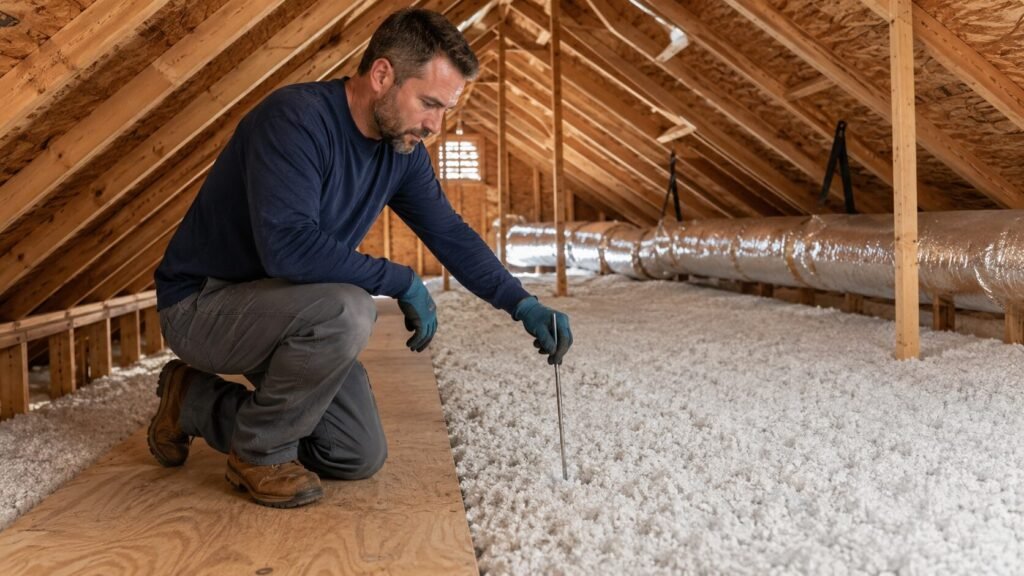
If your home feels hot even while the air conditioner is running, the attic is one of the first places worth evaluating. Insulation slows heat transfer between the attic and the living space below. The amount needed is expressed as an R-value, but reaching the right number takes more than blowing material to a guessed depth.
A professional attic insulation installation should account for the home’s location, existing material, coverage, moisture history, ventilation, air leaks, clearances, and how the attic is built. This guide explains what common R-value references mean and how to turn them into a practical plan for a South Florida property.
Start with the definition
What does R-value measure?
R-value measures how well an insulation layer resists heat flow. A higher number represents greater resistance, but the label alone does not guarantee good performance. Gaps, compression, uneven coverage, wet material, and air movement can reduce the practical benefit of an otherwise suitable product.
Two-zone reference
What R-value is recommended in South Florida?
South Florida is not entirely within one climate zone. ENERGY STAR’s current retrofit table, which is based on 2021 residential energy-code guidance, separates hot-humid Zone 1 from Zone 2. The table below translates those references into homeowner-friendly language.
Practical takeaway: Do not select R-30 or R-49 based only on a broad “South Florida” label. Confirm the property’s climate zone and attic conditions before setting the scope.
Four inputs determine how much insulation you actually need
A target R-value is only one part of the calculation. A useful attic assessment should answer four questions before material is added.
Climate zone
The home’s exact location affects the appropriate R-value reference and applicable requirements.
Existing R-value
Material type, depth, density, compression, and coverage help estimate what is already present.
Material condition
Wet, contaminated, pest-damaged, or badly deteriorated insulation should not simply be covered.
Attic assembly
Vented or unvented design, access, ducts, equipment, eaves, and required clearances shape the installation plan.
Common measuring mistake
Insulation depth and R-value are not the same thing
A ruler can help screen for thin areas, but inches alone do not identify the R-value. Different materials provide different resistance per inch, and settled, compressed, disturbed, or wet insulation may not perform like fresh material installed to the manufacturer’s specifications.
Often estimated around R-2.5 per inch
Often estimated around R-3.7 per inch
Often estimated around R-3.2 per inch
These are rough identification estimates, not installation instructions. Product coverage charts, installed density, manufacturer specifications, and the existing attic determine the actual material quantity.
Attic assessment path
From “How much?” to the right project scope
1
Measure and identify what is there
Check material type, average depth, thin spots, exposed attic floor, compression, and whether multiple insulation layers are present. Measurements should be taken in several representative areas rather than one convenient location.
2
Inspect the attic before covering it
Look for roof or plumbing leaks, staining, pests, odors, blocked soffits, damaged ducts, unsafe wiring concerns, air leaks, and service-access needs. More insulation should not hide a problem that needs to be repaired first.
3
Set the target and material quantity
After confirming the climate reference and existing condition, calculate the additional R-value needed and use the chosen product’s coverage specifications to determine bags, installed depth, and evenness.
Can you add insulation over the existing layer?
Sometimes. Clean, dry, serviceable insulation may remain while additional material improves the overall thermal resistance. Other attics need a clean starting point before the target R-value matters.
Add or improve
Existing material is clean but inadequate
Additional insulation may be appropriate when the current layer is dry and suitable to remain, but coverage is thin, uneven, or below the selected target. Preparation and air sealing should be completed before new material covers the attic floor.
Remove or correct first
Material is wet, contaminated, or damaged
Professional attic insulation removal may be needed when material has moisture damage, pest contamination, persistent odors, severe deterioration, or conditions that require clear access for repair.
For a complete condition checklist, read whether old attic insulation should be removed before adding new material.
Why the same R-value can perform differently in two homes
Insulation works as part of the building system. Two attics can contain the same labeled R-value and still deliver different comfort because the installation and surrounding conditions are different.
- Evenness: Low spots and exposed ceiling areas create weak points where heat transfer can increase.
- Compression: Packing material into too little space can reduce the performance it was designed to provide.
- Air sealing: Gaps around plumbing, wiring, chases, and ceiling penetrations can allow air movement through the thermal boundary.
- Moisture: Roof leaks, plumbing problems, condensation, or humid air reaching cold surfaces can damage materials and must be corrected at the source.
- Ventilation and clearances: Insulation should not block soffit vents, bury equipment access, or cover components that require separation.
- Duct and AC condition: Leaking ductwork or malfunctioning equipment can create hot rooms and long cycles even when the attic insulation is adequate.
South Florida moisture adds another reason to inspect before installing. Learn how humidity can affect air ducts and attic insulation, especially when stains, damp materials, or sweating vents appear.
Before approving a proposal
Ask for these five answers
Insulation and cooling work together
Adequate attic insulation can reduce heat transfer into the living space and make it easier for the AC to maintain temperature. It cannot repair low refrigerant, drainage trouble, failed components, poor sizing, or major airflow problems.
If the home remains uncomfortable after the attic is addressed, consider an air-conditioning inspection and repair.
Set realistic energy expectations
Upgrading a thin or poorly covered attic may reduce energy waste, but results depend on the starting condition, thermostat habits, duct leakage, equipment efficiency, home construction, and weather.
Review the factors behind whether attic insulation can lower a Florida electric bill.
Local attic-insulation help
Attic inspections across South Florida
Duct & AC Masters provides attic-insulation services throughout Palm Beach County, Broward County, and Miami-Dade County, including West Palm Beach, Boca Raton, Delray Beach, Boynton Beach, Wellington, Fort Lauderdale, Miami, and nearby communities.
Because the region crosses climate references and includes many different attic layouts, the team evaluates the individual property before recommending installation depth, removal, or related HVAC work.
Common questions
South Florida attic-insulation R-value FAQ
What R-value do I need for attic insulation in South Florida?
The answer depends on the property’s exact climate zone and existing insulation. ENERGY STAR’s retrofit guidance lists R-30 for an uninsulated Zone 1 attic and R-49 for an uninsulated Zone 2 attic. A professional should confirm the location, attic assembly, existing R-value, and applicable requirements before setting the project target.
Is R-30 attic insulation enough in Florida?
R-30 is the listed uninsulated-attic retrofit reference for Climate Zone 1, but it should not be treated as the automatic answer for every Florida home. Zone 2 guidance, local requirements, the roof-ceiling assembly, and existing insulation can point to a different target.
How many inches of attic insulation do I need?
The required depth depends on the insulation material and product specifications. Loose-fill fiberglass, cellulose, and fiberglass batts provide different R-values per inch. Existing density, settling, compression, and uneven coverage also matter, so depth should be calculated from the selected material and verified across the attic.
Can I add new insulation over old attic insulation?
Often, yes, when the existing insulation is clean, dry, serviceable, and compatible with the new plan. Wet, pest-contaminated, odorous, mold-affected, or severely damaged material may need to be removed after the underlying problem is corrected.
Does a higher R-value always mean better attic performance?
Not by itself. Higher R-value means greater resistance to heat flow, but gaps, compression, moisture, air leaks, blocked ventilation, and uneven installation can reduce real-world performance. The insulation must be appropriate for the assembly and installed consistently.
How do I know whether my attic needs more insulation?
Possible signs include exposed attic-floor areas, visibly thin or uneven coverage, hot ceilings, rooms that are difficult to cool, long AC cycles, or increasing energy use. These symptoms can also come from duct or equipment problems, so an attic and HVAC inspection is more reliable than guessing from one sign.