
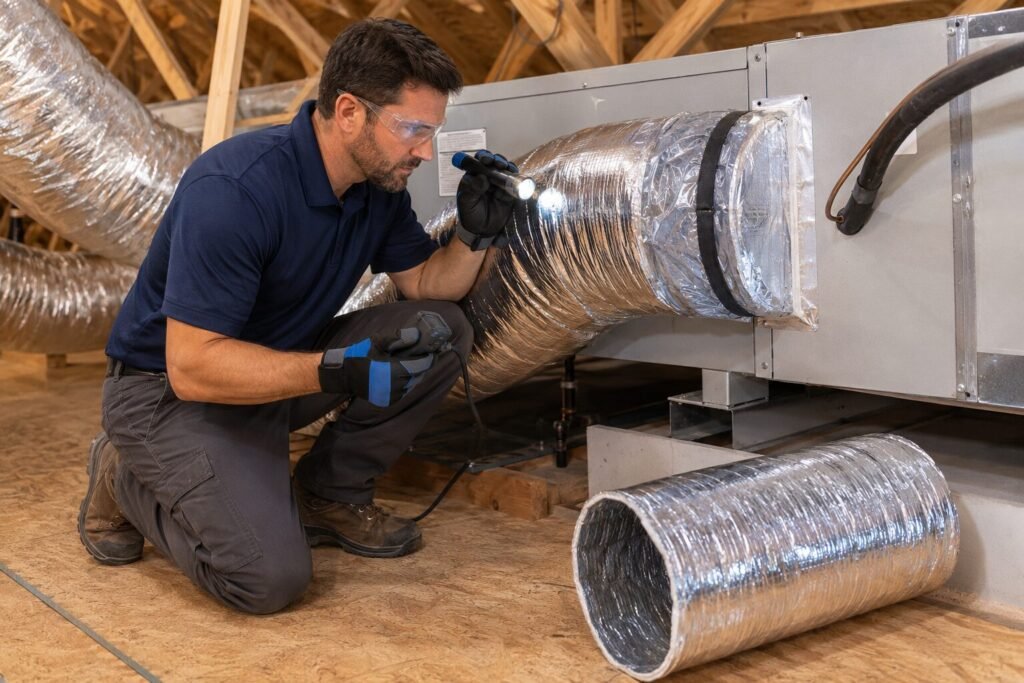
Choosing between air duct repair and replacement is not always as simple as finding one damaged section. The right solution depends on how much of the system is affected, the condition of the duct material, the quality of the original layout, and whether the remaining ductwork can still deliver air efficiently.
Air duct restoration is often the better option when the system is generally sound but has repairable leaks, loose connections, damaged insulation, or a limited number of problem areas. Replacement is usually more practical when damage is widespread, the duct material is deteriorating, the layout is poorly designed, or repeated repairs would only delay a larger project.
For South Florida homeowners, this decision can directly affect room-to-room comfort, cooling costs, indoor air quality, and how hard the AC system has to work. Heat, humidity, long cooling seasons, and hot attic conditions can expose weak connections and aging duct materials faster than homeowners expect.
A trustworthy ductwork recommendation should begin with an inspection, not an automatic push toward the biggest project. This guide explains the difference between restoration and replacement, when each option makes sense, and what a technician should evaluate before recommending the work.
Air Duct Repair vs. Replacement: What Is the Difference?
Air Duct Repair and Restoration
Restoration keeps the usable parts of the existing system and corrects specific problems. The work may include reconnecting loose sections, sealing leaks, repairing damaged areas, improving support, reinforcing ducts, or replacing only the sections that cannot be saved.
Air Duct Replacement
Replacement removes old or failing ductwork and installs a new system or a major new section. It gives the contractor an opportunity to correct deteriorated materials, poor routing, sizing problems, and widespread damage that smaller repairs cannot solve reliably.
The choice is not always all-or-nothing. Some homes benefit from a hybrid approach: restore the portions that remain in good condition and replace only crushed, contaminated, poorly sized, or badly deteriorated runs. That can solve the actual problem without discarding serviceable ductwork.
When Is Air Duct Restoration the Better Option?
Professional air duct restoration makes the most sense when the system has a solid foundation and the problems can be corrected without rebuilding most of the network. These are five common situations where restoration may be the more efficient choice.
The Damage Is Limited
One disconnected run, a small tear, a loose connection, or a few accessible leaks may be repairable without replacing ductwork throughout the home.
Most Duct Material Is Still Sound
If the duct surfaces, inner liners, insulation, and connections remain in usable condition, targeted restoration can preserve the system while correcting its weak points.
The Layout Already Delivers Balanced Airflow
A properly planned system that has developed isolated leaks or support problems may only need repair. There is less reason to replace a layout that is correctly sized and still serves every room well.
Leaks Are the Main Problem
When cooled air is escaping through repairable joints or connections, sealing and reinforcing those areas may improve delivery without the cost and disruption of a full replacement.
A Section-by-Section Solution Is Practical
If one branch is crushed or damaged but the rest of the network is healthy, replacing that branch and restoring nearby connections can be a smarter scope than replacing everything.
Not Sure Whether Your Ducts Can Be Saved?
Duct & AC Masters can inspect the system, show you where the problems are, and explain whether restoration, partial replacement, or full replacement makes the most sense for your property.
When Is Air Duct Replacement the Smarter Choice?
Targeted repairs lose their value when too much of the system is failing. In that situation, professional air duct replacement can provide a more dependable long-term solution and correct problems that sealing alone cannot address.
Replacement may be recommended when:
- Damage, leakage, or deterioration appears throughout multiple sections.
- Flexible ducts are crushed, torn, brittle, sagging, or no longer properly supported.
- Metal ductwork has significant corrosion or joints that repeatedly separate.
- The original system is poorly sized, routed, or balanced for the property.
- Insulation around the ducts is badly damaged or cannot control condensation effectively.
- Pest activity, water intrusion, or other contamination has compromised material that should not remain in service.
- Past repairs have not solved recurring airflow, dust, odor, or comfort problems.
- A major AC replacement or renovation changes the airflow needs of the home.
Age matters, but it should not be the only deciding factor. Older ducts in good condition may still be repairable, while newer ducts that were poorly installed or damaged in an attic can need substantial replacement. The present condition and performance of the system are more useful than the installation date alone.
If you are already seeing weak airflow, hot rooms, rising bills, or visible duct damage, review these additional signs your air ducts may need replacement instead of cleaning.
What Should a Professional Duct Inspection Check?
An air duct repair vs. replacement recommendation is only as reliable as the inspection behind it. The technician should look beyond the vent covers and consider the entire air-delivery path.
Physical Condition
Look for tears, holes, crushed sections, corrosion, loose joints, sagging runs, and damaged insulation.
Airflow and Comfort
Compare airflow between rooms and identify branches that are restricted, disconnected, leaking, or poorly balanced.
System Design
Review duct sizes, routing, return-air capacity, connections, and whether the layout matches the home’s cooling needs.
Moisture and Contamination
Identify condensation, water damage, pest damage, debris, odors, or material that may be unsuitable to leave in place.
The inspection should also consider the AC equipment and attic. A duct problem can look like an equipment problem, and poor attic insulation can contribute to hot rooms even when the ducts are working. Evaluating the systems together helps prevent spending money on the wrong fix.
Does Air Duct Restoration Cost Less Than Replacement?
Restoration often costs less because the scope is smaller and much of the existing system remains in place. However, the actual price depends on accessibility, the number of damaged areas, the duct material, attic conditions, home size, and how much sealing or partial replacement is required.
The lowest initial price is not always the lowest long-term cost. Repeatedly patching a widely deteriorated system can become more expensive than replacing it correctly. On the other hand, replacing every duct when only one branch is damaged can create unnecessary expense. The best value comes from matching the scope to the condition of the system.
Questions to ask before approving the work
- Which exact sections are damaged, and can I see the problem?
- Is the issue localized or present throughout the system?
- Will repair solve the cause or only cover the symptom?
- Can a partial replacement preserve the ducts that are still serviceable?
- Does the current layout properly serve every room?
- What results should I expect for airflow, comfort, dust, or energy waste?
Why South Florida Ductwork Needs a Local Evaluation
Ductwork in Palm Beach, Broward, and Miami-Dade counties often runs through very hot attic spaces while the AC operates for much of the year. Loose seals, damaged insulation, and air leaks can waste cooled air before it reaches the living space. Humid conditions can also make condensation and moisture damage more important to address quickly.
Duct & AC Masters provides duct inspections and repair options throughout Palm Beach County, Broward County, and Miami-Dade County. The team is licensed and insured and works with homeowners and businesses across South Florida.
Get a Clear Air Duct Recommendation
If your home has weak airflow, hot rooms, rising energy bills, excess dust, or visible duct damage, schedule an inspection. Duct & AC Masters will help you understand what can be restored and what, if anything, should be replaced.